As we think about the importance of understanding anatomical relationships I would like you to consider the following two scenarios:
After you gather your luggage at the airport you grab a ride and tell the driver to take you to the corner of State and Lake in downtown Chicago. Having grown up in Chicago you know that the most of the city is laid out in a north-south/east-west grid. Lake Street runs east and west, and State Street runs north and south. The hotel where you are meeting your roommate is slightly east of the corner of State and Lake. When you enter the hotel lobby you text your roommate and he tells you to come up to the room that both of you will be sharing. The room number is 22, but he doesn’t tell you what floor the room is on, and the hotel has fifteen floors, each with 30 rooms!
Upon returning to the apartment the handyman has just finished his work and is packing up his tools and preparing to leave. This is what you see when you look at one location where you wanted the new outlets placed:
When you ask why the outlets are not set into the walls the handyman replies “I don’t know what is behind that wall! If I cut a hole in the wall I might hit a pipe or an electrical wire!”
Think about these two scenarios: In the first you know how to get to the hotel, because you know how far east and west the hotel is on Chicago’s grid system of streets. In other words, you know the x and y coordinates of the hotel. However, upon entering the hotel you do not know the “z” coordinate—how far up you must go in order to be on the correct floor! You have enough information to find the hotel, but you do not have enough information to find the hotel and the room within the hotel.
The electrician also knows the x and y coordinates of where you want the electrical outlets. What he does not know is what lies deep to the wall and, therefore, does not know how deep he may go before he hits a pipe or an electrical wire—he also does not know the “z” coordinate.
In both of these scenarios one needs to know three dimensional relationships in order to find the correct hotel room and where to correctly place an outlet without hitting anything deep within the wall.
But how do these two scenarios apply to human anatomy? Why is it important to know and understand anatomical relationships? Let’s explore that question.
Students of human anatomy need to know from the first day of class that anatomy is a complex and difficult subject. Just three of numerous, and sometimes intimidating aspects of the subject are:
-
Anatomy has its own vocabulary. At first, this new vocabulary seems like a foreign language. And, as difficult as it is, this vocabulary must be mastered immediately.
-
There is a lot to know, because, sooner or later, you will be asked to understand the anatomy of almost every structure within the human body.
When studying human anatomy one must know more than “what is it and where is it?” To truly know and understand human anatomy you must understand anatomical relationships. The successful mastery of human anatomy requires a balance between memorization, understanding, and visualization. Deeper approaches to learning anatomy—meaning attempts to understand the subject matter instead of just memorizing names—correlate strongly with a true 3-dimensional understanding of the subject as a whole.
Studying anatomy in only two dimensions limits one’s complete understanding of the human body, simply because all anatomical structures are three-dimensional, and every structure has a relationship with many other structures. Studying anatomy in three dimensions allows for a more thorough understanding of the body. Anatomy is often described as being the foundation of medicine, in that a thorough understanding of human anatomy is crucial for healthcare professionals. It also allows for a better comprehension of how the different structures within the body relate to each other. In addition, this understanding of anatomical relationships—the spatial, physical, and functional connections between structures—is essential for informed decisions in surgical procedures, diagnoses, treatment, and much more. All of these would be much more difficult, if not impossible, without a three-dimensional understanding of anatomy. Such an understanding also ensures precise communication between anatomists, as well as among healthcare professionals. It also helps in interpreting anatomical imaging, and aids in the understanding of how structural arrangements dictate physiological functions.
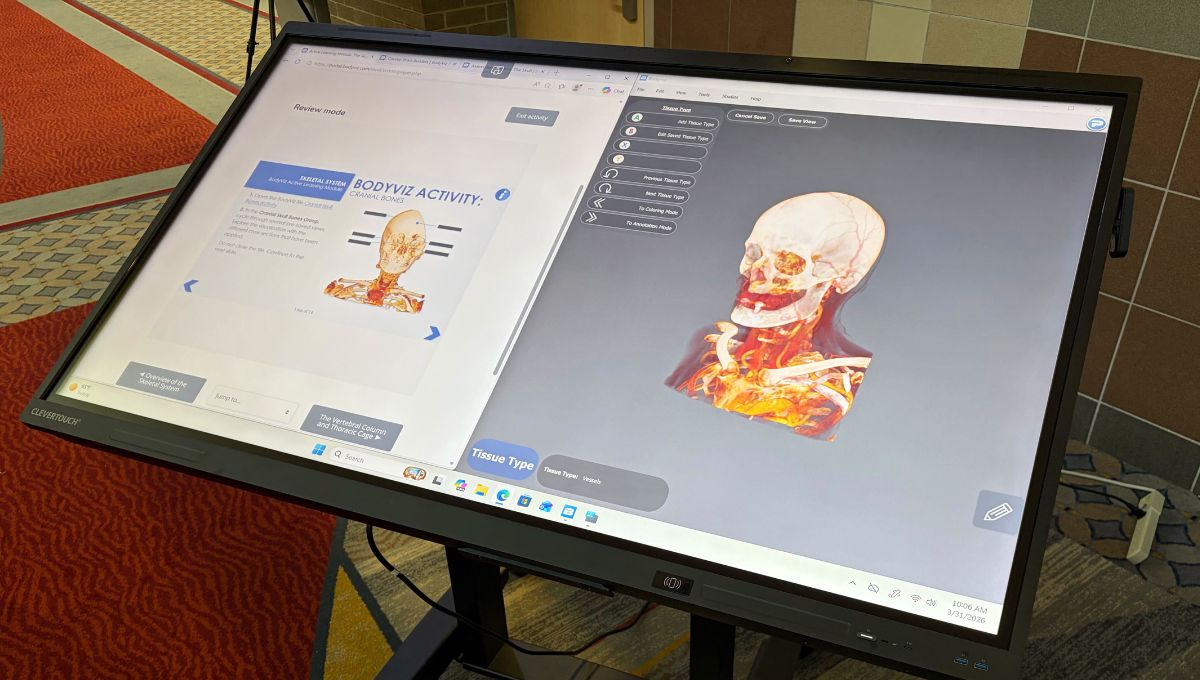
I taught Human Anatomy at my home institution for 43 years. My courses involved both lecture and laboratory. In the laboratory, students were able to experience three-dimensional anatomy through the use of high-quality models and the hands-on process of dissecting an anatomical donor. However, for a variety of reasons, the lab was not open 24 hours a day. This required my students to study utilizing their textbook when the lab was not open. No matter how excellent a textbook is, it is a two-dimensional learning tool. This made a difficult subject even more difficult, because it required students to mentally rotate those static images and try to determine what structures lie medial to, lateral to, or deep to the structure in question. For some students, this mental exercise was nearly impossible.
So...what is the best way for students to obtain a solid three-dimensional understanding of human anatomy? The best way has been, and still is the dissection of an anatomical donor.
I remember when I met my “first patient” — the term used in my gross anatomy class at the University of Wisconsin School of Medicine to describe the anatomical donor that I and the others at our dissection table would be dissecting. Even before we pulled the sheet back we had a long discussion about the respectful way to treat the donor, as well as the do’s and don'ts about the procedures to be followed in the lab. Then the sheet was pulled back, I reviewed the surface anatomy of the area we were to dissect, and I made my first cut through the skin and into the subcutaneous tissue. I have never been the same since. I, and everyone at my dissection table, was astonished by the extent to which an anatomical specimen differed from the images in our texts. The variations, be they large or small, in the anatomy of the various anatomical donors within the lab was amazing. Some structures varied in size, location, and appearance. Each student enrolled in my classes at my home institution expressed the very same awe and excitement each and every day of my 43 years of teaching.
As I mentioned previously, to truly know and understand human anatomy one must know more than “what is it and where is it?” Some of my favorite questions for students, be it in lecture or lab, was to name or point to a structure and ask one or more of the following questions:
-
What structure lies medial or lateral to the one I named or am pointing to?
-
What structure lies deep to the one I named or am pointing to?
-
What route do the nerves that innervate this structure take to get from the central nervous system to this structure?
-
What route do the arteries that supply this structure take to get from the aorta this structure?
-
What route do the veins that drain this structure take to get back to the vena cava?
But, to be honest, there are both positives and negatives to dissecting an anatomical donor. Positives include, but are not limited to,
-
Hands-on anatomical experience
-
An enhanced three-dimensional understanding of human anatomy
-
Tactile feedback to the student, in that students are able to feel the difference between the different human tissues and organs
-
The exposure to anatomical variability
-
The respect for human life
Negatives include, but are not limited to,
-
Ethical and emotional challenges for students and faculty
-
Health and safety concerns
-
Time-consuming learning, in that it takes a lot of time to properly dissect an anatomical donor
So, this raises the following question: If an institution is unable or unwilling to go through the process of developing, utilizing and maintaining a gross anatomy lab, how do students obtain this three-dimensional understanding of human anatomy?
The SoTL (Study of Teaching and Learning) literature strongly demonstrates the need for anatomy students to utilize two-dimensional and three-dimensional learning tools as they learn the required content. The use of such tools will enable the student to achieve a high level of anatomical knowledge and understanding. The SoTL literature points to numerous forms of teaching and learning tools that aid students in their development of a three-dimensional understanding of human anatomy. Some of these forms include
-
High-quality and accurate skeletal and anatomical models
-
Computer-based three-dimensional methodology
-
Augmented reality
-
Virtual reality
-
Utilization of real MRI, CT and x-ray patient data
Numerous SoTL studies demonstrate that the above forms of three-dimensional methodologies can be very effective means of learning and understanding anatomical information, including anatomical relationships. However, as with any ancillary teaching techniques or objects, the two most important factors in a student’s ability to learn and understand human anatomy is the quality of the faculty member teaching the class and the effort and commitment of the student towards mastering the required subject matter.
So, an excellent student of anatomy who knows and understands anatomical relationships knows much more than the location of the rectus femoris muscle on the anterior surface of the thigh. He/she/they also know the anatomical relationships of the following structures to the rectus femoris muscle:
-
Great saphenous and anterior femoral veins, femoral artery, and the deep femoral artery
-
Lateral femoral nerve and the anterior cutaneous branches of the femoral nerve
-
Sartorius, vastus medialis, vastus lateralis, vastus intermedius, tensor fasciae latae, pectineus, adductor longus, adductor brevis, adductor magnus, gracilis, iliopsoas muscles
Is this a lot to know and understand? Yes it is! But, as was mentioned at the start of this piece, there is a lot to know when you study the anatomy of the human body—much, much more than “what is it and where is it?” To truly know human anatomy one needs to know and understand anatomical relationships—the ability to visualize the human body in three dimensions. When you can do that you truly know your subject matter!