BodyViz 3D Anatomy Software Is Now Available on zSpace
October 20, 2026
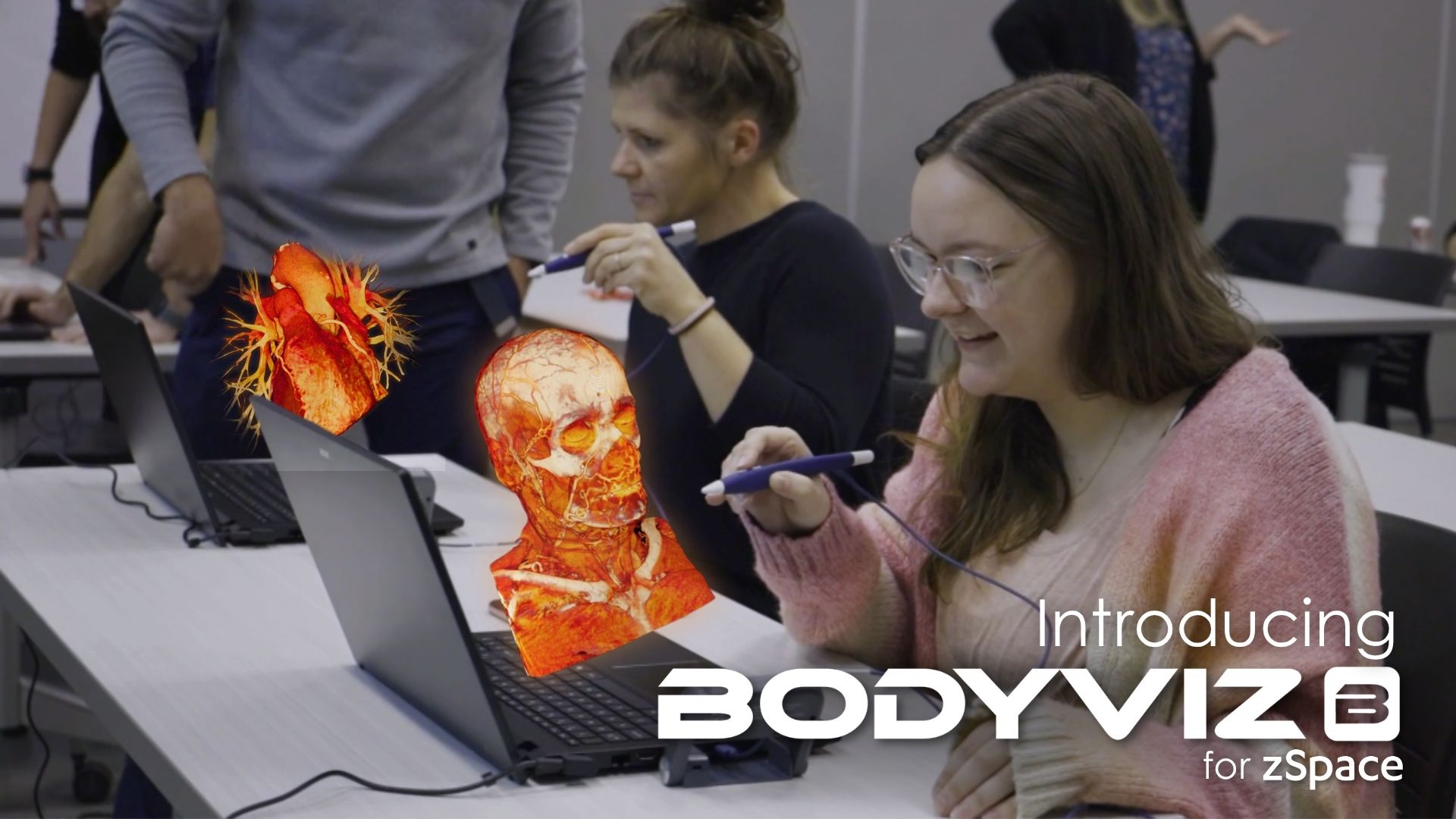
Technology continues to expand the ways students can explore and understand anatomy. Now, BodyViz 3D Anatomy Software is available on the zSpace platform, bringing interactive human and veterinary anatomy into an immersive learning environment. The collaboration combines BodyViz’s interactive anatomy content with zSpace’s immersive 3D technology, allowing students to interact with anatomy in a virtual 3D space and giving educators a new way to incorporate anatomy exploration into the classroom.
“Our partnership with zSpace creates an exciting new way for students to experience BodyViz. By bringing real-patient anatomy into an immersive environment, we’re giving educators another tool to make anatomy more interactive, accessible, and meaningful for students.”
— Scott Rodenburg, VP of Business Development, BodyViz
As a leader in immersive AR/VR education technology, zSpace supports learning experiences across STEM, healthcare, career and technical education (CTE), and other educational programs. Bringing BodyViz 3D Anatomy Software to the zSpace platform provides educators with another option for incorporating interactive anatomy into their existing curriculum and gives students a hands-on way to investigate 3D anatomy.
Bringing BodyViz 3D Anatomy Software to zSpace
Anatomy instruction often requires students to translate two-dimensional images into an understanding of three-dimensional structures and relationships. BodyViz and zSpace give students another way to make those spatial connections by allowing them to interact with 3D anatomy in an immersive environment.
BodyViz uses real-patient MRI and CT scans to create interactive 3D anatomy that students can explore and virtually dissect. BodyViz Human Anatomy Software and Veterinary Anatomy Software content can now be explored through zSpace using the same established views available in BodyViz. Students can rotate anatomy, zoom in on areas of interest, examine spatial relationships, and work through virtual dissections and learning activities using zSpace’s interactive tools. This experience is designed to complement, rather than replace, existing anatomy instruction. Educators can incorporate BodyViz for zSpace alongside lectures, laboratory experiences, physical models, and other course materials to give students another way to explore the concepts they are learning.
Exploring BodyViz Anatomy in zSpace
Content available through the BodyViz Portal maintains the same prepared views found in the BodyViz application, allowing students to rotate, zoom, pan, and explore anatomy from different perspectives; while giving students a focused set of tools for exploring anatomy. Using the zSpace stylus, students can interact directly with 3D anatomy in the virtual environment. The stylus allows students to grab and manipulate a scan, making it possible to rotate structures and examine anatomical relationships from different angles. Keyboard shortcuts and compatible gamepads also provide additional ways to navigate the real anatomical scans.
Prepared BodyViz views retain the features built into them, including clipping planes, colors, annotations, and other elements created within BodyViz. Rather than giving students access to BodyViz Pro editing tools, the zSpace experience provides a focused environment for interacting with prepared anatomy and completing assigned learning activities.
Students can also work through BodyViz Portal activities. Labeling activities allow students to identify structures, show or hide answers, and receive immediate visual feedback based on their selections. Students can move between exploring anatomy in 3D and continuing their accompanying learning modules, connecting the immersive experience directly to course content.
Connecting Immersive Exploration With Anatomy Learning
The value of interactive anatomy goes beyond simply viewing a structure in 3D. Students need opportunities to investigate how structures are positioned, how they relate to surrounding anatomy, and how those relationships change as they examine the body from different perspectives. With BodyViz for zSpace, students can actively manipulate anatomy rather than relying solely on static images. They can revisit prepared views, examine dissections from multiple angles, and use interactive activities to apply what they are learning.
Content available through the BodyViz Portal allows immersive exploration to be incorporated into existing anatomy lessons and activities. This helps educators connect 3D interaction with structured learning objectives rather than treating immersive technology as a standalone classroom experience.

Supporting Human and Veterinary Anatomy Education
With BodyViz Human Anatomy Software and Veterinary Anatomy Software available for zSpace, educators can incorporate immersive anatomy exploration across a range of healthcare and animal science programs. The integration gives instructors flexibility to use BodyViz for demonstrations, collaborative activities, independent exploration, or guided learning activities.
Students can investigate anatomical structures and relationships while connecting what they see in 3D with concepts covered in their coursework. For veterinary programs, BodyViz also provides opportunities to explore anatomy using real animal imaging, helping students connect anatomical concepts with veterinary applications. By making interactive anatomy available within the zSpace environment, educators have another option for incorporating 3D visualization into the way they teach human and veterinary anatomy.
Bringing Anatomy to Life in a New Way
The availability of BodyViz on zSpace gives educators a new way to bring interactive human and veterinary anatomy into immersive learning environments. By combining BodyViz anatomy content with zSpace’s interactive technology, students can explore anatomy, complete learning activities, and build their understanding through hands-on interaction with 3D structures.
Interested in seeing BodyViz for zSpace in action?
Click here for more information and to explore how the integration can support anatomy education in your classroom.